Every housing report coming out of Fairfax County this year tells a similar story: more homes for sale, longer waits, and buyers finally catching a break after years of getting outbid. If you have been watching the market from a distance, that story probably shaped your expectations. Wait a little, the logic goes, and more options will appear, sellers will get more flexible, and you will have room to negotiate.
Walk that expectation over to Lakeshire Drive, Marble Dale Court, Riverton Lane, or Centerbrook Place, the four streets that make up The Manors at Mount Vernon, and it starts to fall apart. Not because the county data is wrong. Because a subdivision this small was never going to move the way a county of more than a million people moves, and understanding why matters more than the headline number if this is the neighborhood you actually want.
What the county numbers are measuring
The county-wide story is real. Active listings across Northern Virginia rose 45.1 percent year over year as of November 2025, and forecasts from the Northern Virginia Association of Realtors and George Mason University's Center for Regional Analysis called for single-family inventory in Fairfax County specifically to climb another 35.8 percent through 2026. Days on market crept up too, with the county average sitting somewhere between 25 and 46 days depending on which tracking service you check, compared to the faster pace buyers remember from 2021 through 2023.
Zillow's home value index put the average Fairfax County home at $760,599 as of the end of August 2026, up a modest 0.9 percent over the prior year. Redfin's numbers ran a bit hotter, showing a median sale price of $813,000 over the three months ending in May 2026, up 3.4 percent year over year, with homes still going under contract in about 25 days on average. Countywide reporting on the first half of 2026 put the median closer to $780,000 and the average price for detached single-family homes above $1.28 million, a double-digit jump from the year before.
None of these figures contradict each other so much as measure slightly different slices of a very large, very active market. That is the point. Fairfax County closes more than a thousand homes a month across dozens of school districts, hundreds of subdivisions, and every price point from starter condos to seven-figure estates. When that many transactions happen every month, statistical patterns emerge naturally. New construction fills gaps. Retirees sell and move to smaller places. Job transfers bring fresh listings year-round. The system has enough moving parts to behave like a system.
What The Manors at Mount Vernon actually is
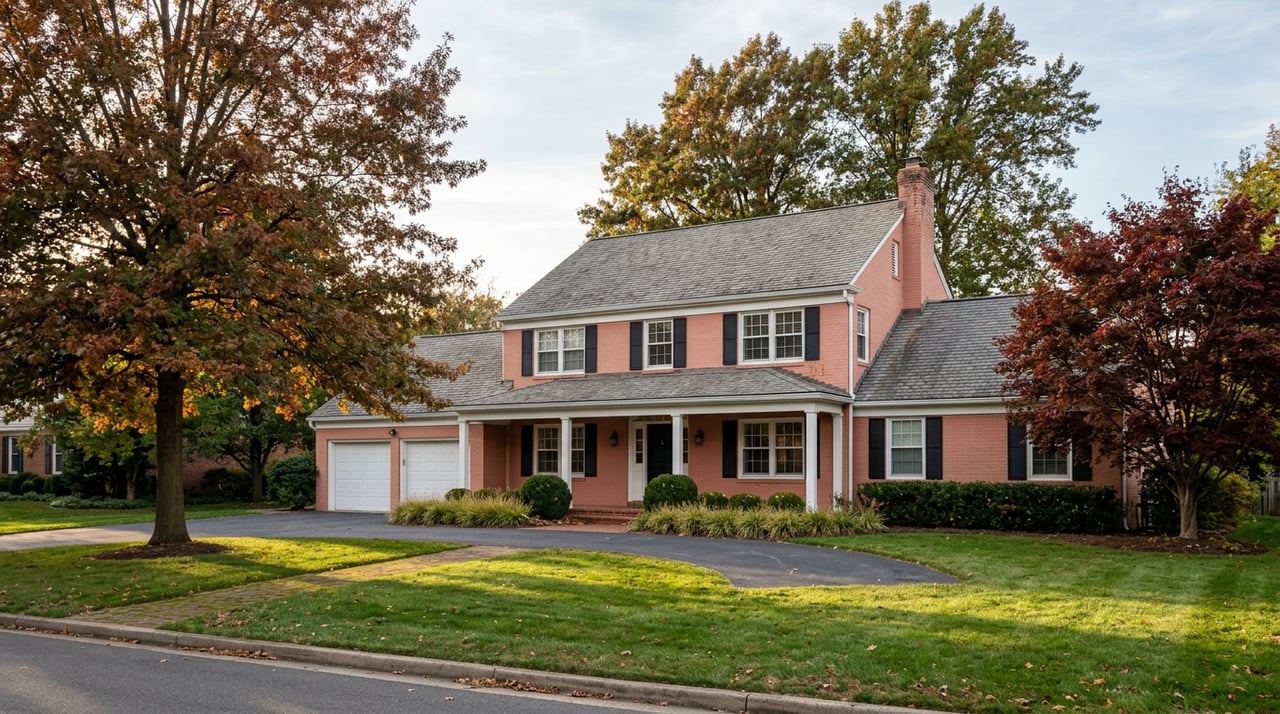
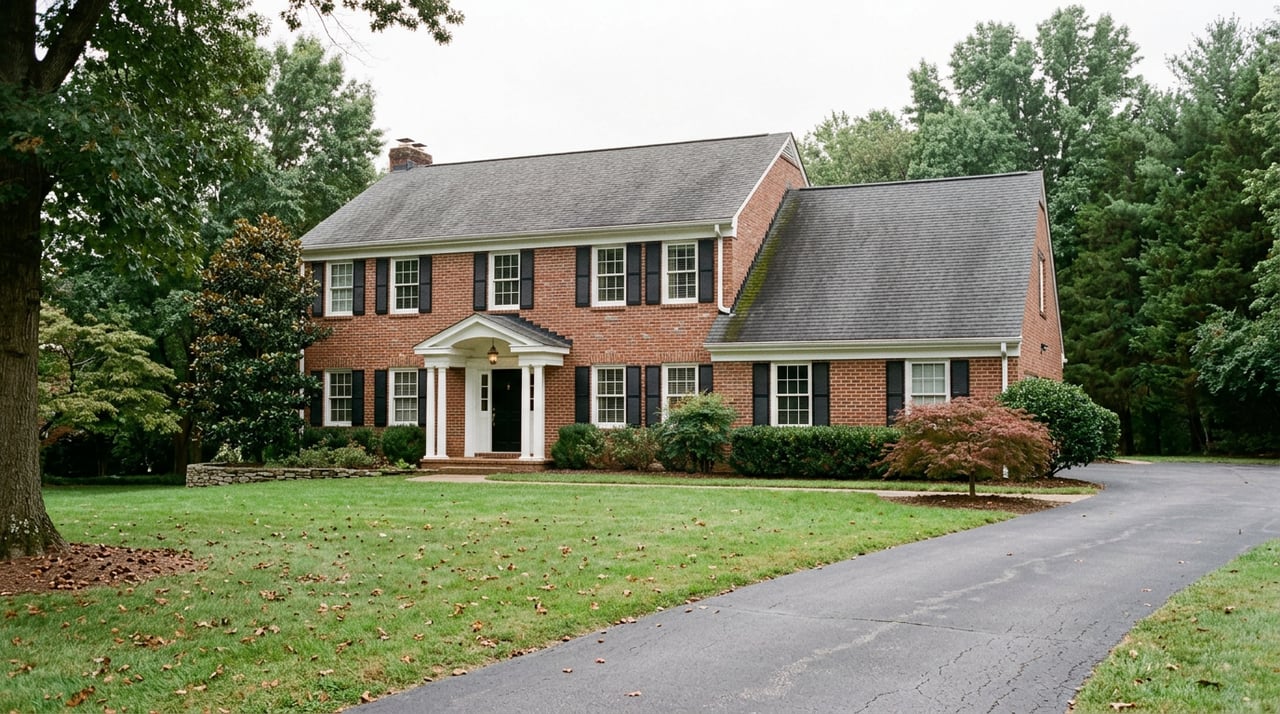
The Manors at Mount Vernon is not a system. It is a single, small subdivision built out in one construction wave during the late 1980s and early 1990s, tucked along North Branch Little Hunting Creek in the Fort Hunt section of Alexandria. The homes sit on generous wooded lots, mostly four and five bedrooms, mostly center hall colonials, connected by non-thru streets that end in cul-de-sacs rather than feeding into each other. Families here are zoned for Stratford Landing Elementary and Carl Sandburg Middle School, with West Potomac High School at the high school level.
| What you're comparing | Fairfax County (2026) | The Manors at Mount Vernon |
|---|---|---|
| Housing stock built | Continuous, decades of new construction | One build era, late 1980s to early 1990s |
| Number of streets | Thousands | Four |
| Street pattern | Through streets, connected grid | Cul-de-sacs, non-thru |
| Typical annual turnover | Thousands of closings | A small handful of homes |
| Comparable homes for pricing | Broad, cross-neighborhood datasets | Almost entirely each other |
There is no builder actively adding inventory here. There has not been for more than thirty years. Every home that could ever be part of this neighborhood already exists, which means the entire supply of Manors at Mount Vernon houses is whatever the current owners decide to do, nothing more.
Why the county's loosening market can't reach four streets
This is the part that gets lost when buyers read a county report and assume it applies evenly to every pocket inside it. A 45 percent jump in countywide inventory is an aggregate of thousands of individual decisions, distributed across a huge geographic and demographic range. Some of that increase comes from new subdivisions delivering their first closings. Some comes from investors listing rental properties. Some comes from older neighborhoods where a wave of long-time owners happens to retire in the same window.
The Manors at Mount Vernon has almost none of those inputs available to it. There is no new construction pipeline to add fresh listings. The neighborhood is small enough that even a normal, healthy amount of turnover, maybe two or three homes changing hands in a given year, looks statistically enormous relative to the total number of houses on those four streets, while remaining completely invisible in a countywide inventory count of tens of thousands.
There is also a behavioral piece worth naming honestly. Cul-de-sac neighborhoods like this one tend to hold onto residents longer than through-street neighborhoods do. Less passing traffic, more contact between neighbors, kids who grow up walking to each other's driveways rather than crossing busy roads. Real estate agents describe it as a close-knit community, and that closeness is not just a lifestyle detail. It is an economic one. People who feel genuinely settled somewhere are slower to test the market, slower to list opportunistically, and more likely to wait for a real reason to move rather than a favorable data point.
Put those two things together, a fixed housing stock with no construction pipeline and an ownership pattern that favors staying put, and you get a neighborhood that is structurally insulated from the countywide inventory story. Fairfax County can add tens of thousands of listings and Manors at Mount Vernon can still see zero homes hit the market in a given month. Both things are true at the same time, and neither one is a contradiction of the other.
What this means if you're actually watching this pocket of Fort Hunt
If you are hoping to buy here and have been holding off because county reports suggest better negotiating conditions are coming, it is worth separating what is likely to loosen from what almost certainly will not. Broader Fort Hunt and the wider county may well see more choices and softer terms as 2026 continues. This specific subdivision is unlikely to follow that pattern in any meaningful way, simply because there are not enough homes here for a trend to express itself. Waiting for a wave of new Manors at Mount Vernon listings is waiting for something the neighborhood's own geometry makes unlikely.
That also means pricing here behaves differently than pricing in a larger, more liquid part of the county. When there are only a few comparable sales to reference, each one carries outsized weight in how the next listing gets priced and how appraisers value it. A single well-documented renovation, or a single home that sits longer than expected, can shift the comparable set for the whole street in a way that would barely register in a neighborhood with hundreds of annual closings.
For sellers, the flip side is real leverage. A homeowner in this subdivision is not competing against the county's rising inventory. They are competing against three other streets' worth of houses, most of which are not for sale in any given season. Thoughtful preparation and clear presentation matter here precisely because there are so few comparables for a buyer to weigh a listing against.
A few questions worth asking before you write an offer
If Fairfax County inventory keeps rising through 2026, will that eventually reach The Manors at Mount Vernon too? It is possible, but the mechanism would need to be local, not countywide. A cluster of long-time owners deciding to sell around the same time, for reasons specific to this neighborhood, would move the needle far more than anything happening in the broader county market.
How should I compare a Manors at Mount Vernon listing to homes elsewhere in Fort Hunt? Carefully, and with attention to what is actually comparable. A single-build-era, non-thru-street enclave with its own microclimate of buyer demand does not price the same way as a neighborhood with a wider mix of home ages and a busier resale calendar.
Does the county's slower days-on-market trend apply here? Not reliably. With so few listings, a single home that sells quickly or sits for a while says more about that specific property than about any trend affecting the neighborhood as a whole.
If you are trying to figure out what a specific street's history actually tells you, or how a Fort Hunt subdivision like this one really behaves compared to the county numbers you are reading online, that is exactly the kind of question worth talking through before you commit to a strategy. The Lauren Kolazas Group has spent years watching how these Fort Hunt pockets move, and would be glad to walk through what it actually looks like on the ground. Let's Connect.